Research
Research
Political theory and economic anthropology, at the intersection of finance, gender and empire.
My research sits at the intersection of political theory and economic anthropology. Empirically, my fieldwork has spanned multiple scales of governance and financial practices as I ethnographically engage with international institutions, state regulators, local communities and women's everyday financial lives. Theoretically, I am interested in racial capitalism and imperial residues that persist in contemporary finance. My ethnographic research is historically embedded and locates present economic processes in social-economic globalised histories. Here is a summary of my three key research domains:
Social reproduction, labouring amidst unemployment and expansion of finance
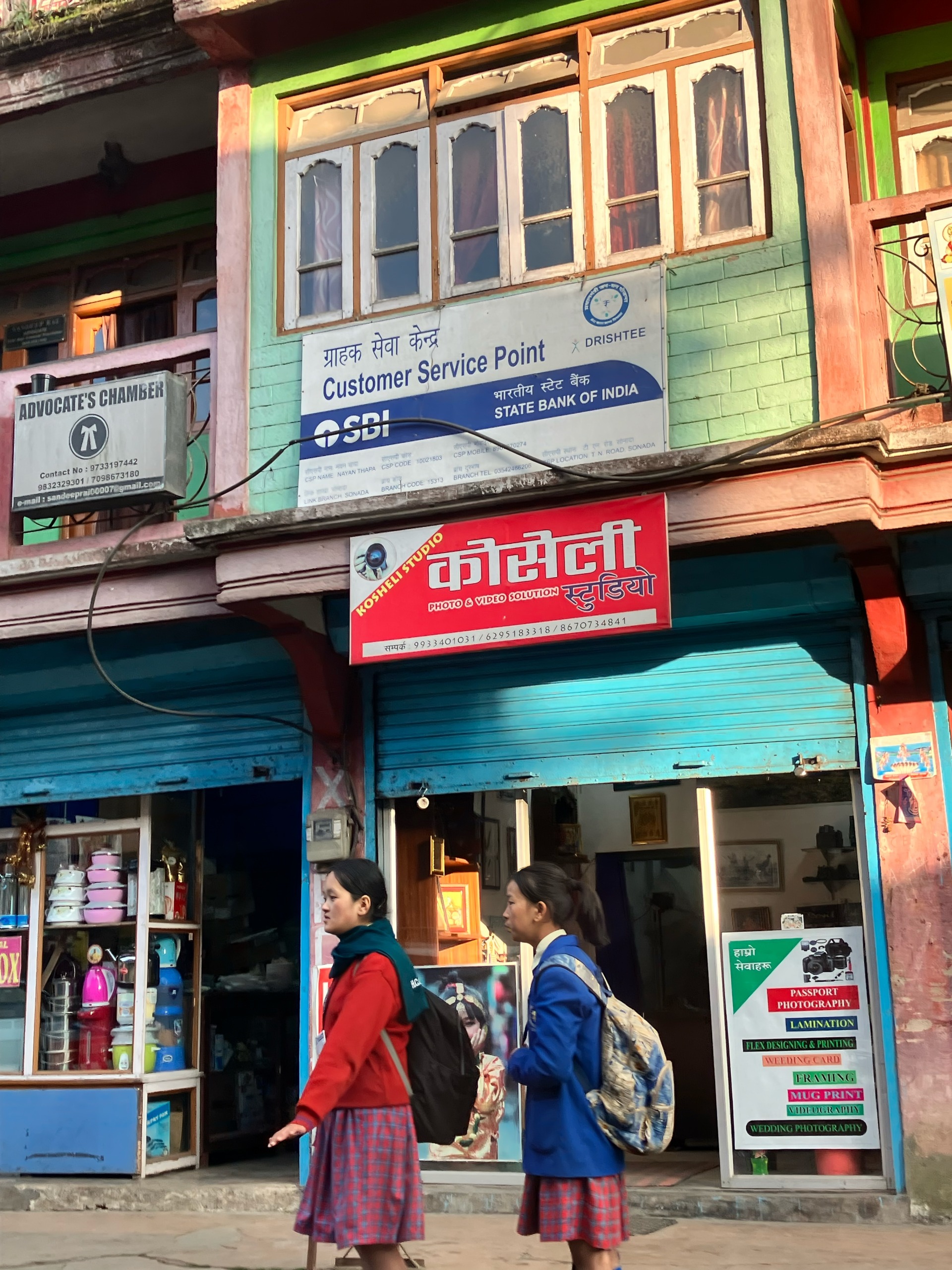
Schoolgirls pass by a local lending point as credit enters ordinary life.
How do people labour to survive in contexts of rampant joblessness? I research how contemporary finance intersects with and capitalises upon women's social reproduction, and how women's domestic labour is used for the direct creation of financial value. In my prior research, I have ethnographically traced financial labour and investments made from Geneva, Switzerland into India's microfinance institutions and ultimately to the women borrowers who take on credit to survive. My research looks at the multiple strategies women use to repay credit and ensure positive credit scores. I am broadly interested in the capitalisation of social reproduction amidst the wider context of jobless growth in the South. This results in new (and sometimes continued) forms of labouring that cannot be mapped onto prototypes of "production" or "service sector" work. I am currently theorising diverse forms of labour in a forthcoming journal article, to elicit relations between (gendered) labour, finance and everyday life.
The Platform State and hybrid financial governance

"The state is a platform" — from a presentation on financialised statecraft.
I research new forms of financial governance including hybrid governance and what is labeled "self-regulation" of the financial sector. I interrogate how the state, especially the postcolonial state, is rendered transformed with increased financialisation of the household — something I am conceptualising as the Platform State (article forthcoming). This includes looking at changing state roles in relation to welfare and development provision, state facilitation of private finance, financialisation of the state and the active constitution of digital financial infrastructures by the state for private actors. I empirically look at the consequent changes to citizenship that the platformisation of state results in as citizens are moulded into financial customers who must participate in financial-digital markets to access basic services. I am currently researching this in the context of India and Brazil, two "leaders" in designing digital financial infrastructures and new platformised forms of statecraft.
Racial capitalism and imperial residues

"Imperial remains: vernaculars of finance" — an archival view of the Bank of Bengal, Calcutta.
My research has driven me to sites where imperial residues are impossible to ignore. Current financial architecture and lending practices in India for instance are closely intertwined with imperial financial design as evident in the Bengal region. The Life Insurance Corporation (LIC) India is one such site, which issues credit life insurance to all microfinance borrowers as a security for financial institutions in case the borrower dies in the course of a loan. This carceral financial form is embedded in the LIC's long history, with its origins in 1818 — aimed at insuring European bodies in "risky" geographies such as the subcontinent. In law, economic architecture and financial design, these imperial residues remain present and demarcate certain lives as more "risky" and financially disposable. I continue to research these imprints of empire in contemporary financial arrangements.
I am also deeply committed to creating more inclusive economic-financial systems and with this goal, regularly assist and collaborate with government institutions, think tanks, NGOs and international organizations to produce research that can create effective, real-life changes in the lives of people who use financial services. Some recent examples of knowledge exchange, collaboration and outreach are discussed under Public Engagement.
© 2026 Tanushree Kaushal. All rights reserved.